 By mason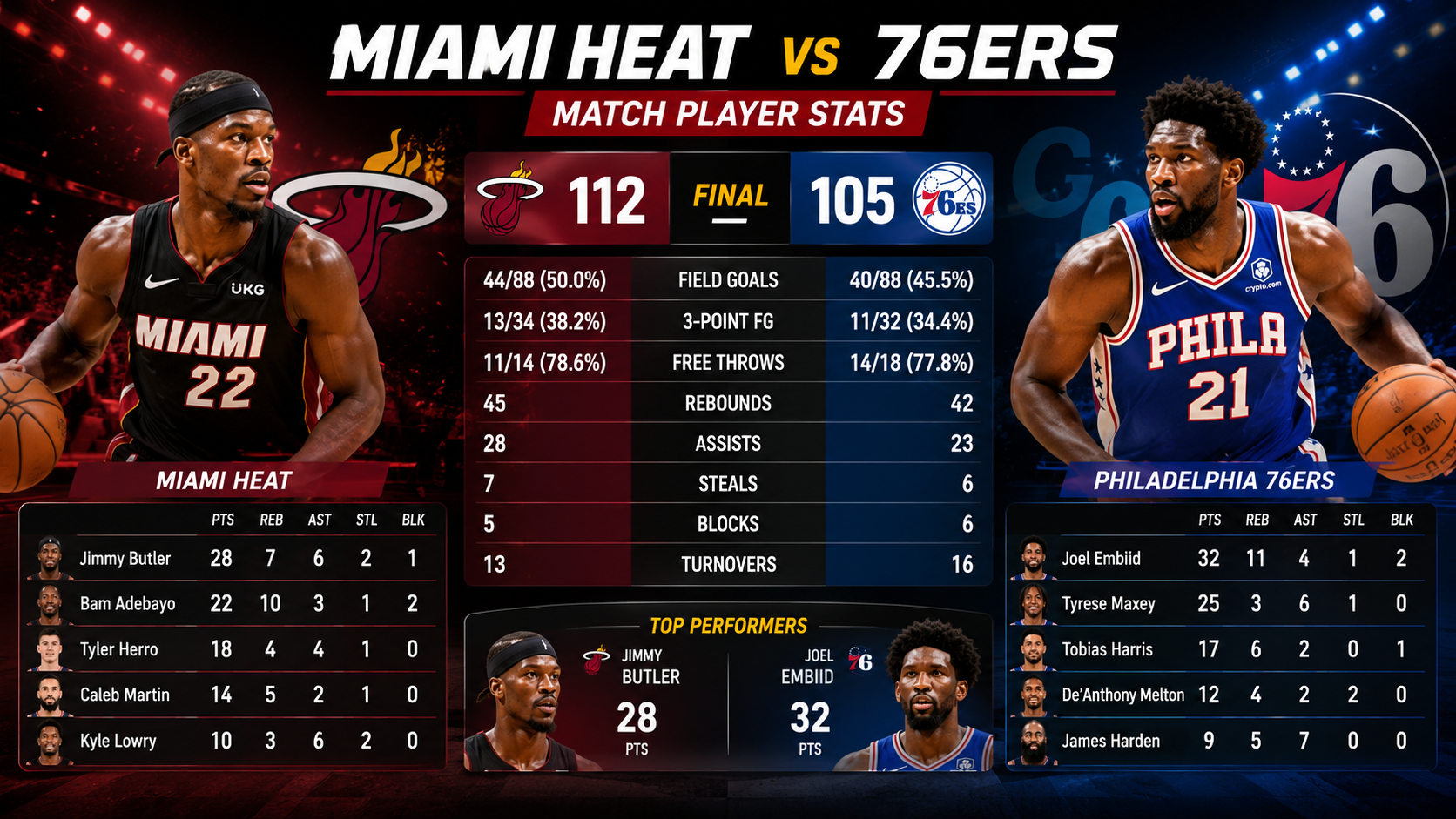
A final score only gives you half the story. To really understand a game, you need to look at what happened on the floor — who took over, who quietly controlled the margins, and how the matchups played out possession by possession. For the Miami Heat vs Philadelphia 76ers series, digging into the box scores, shooting splits, rebounding numbers, and plus/minus figures gives fans and analysts alike a much fuller picture than the scoreboard alone. Here’s a breakdown of how to read those numbers and what they reveal about this rivalry.
Starting With the Box Score
Before you can analyze anything deeper, you need a handle on the basics. Take the April 7, 2025 matchup, where Miami came out on top 117–105. The core numbers — points, rebounds, assists, steals, blocks, turnovers, and shooting percentages across two- and three-point range plus free throws — form the backbone of any stat breakdown.
But the box score also carries subtler indicators, like plus/minus (team performance while a given player is on the floor) and efficiency scores that blend several stat categories into one. These figures capture more than raw output; they show how a player’s presence shaped the flow of the game on both ends.
In that April game, Duncan Robinson put up 21 points, with a dozen of them coming in the fourth quarter, while Kel’el Ware turned in 19 points and a career-best 17 rebounds. Davion Mitchell chipped in 12 points and nine assists, splitting his time between scoring and setting up teammates, and Kyle Anderson rounded things out with steady all-around play off the bench.
Who Scored, and How Efficiently
Points are the easiest stat to notice, but efficiency is what separates a good scoring night from a truly impactful one. Tyler Herro put up 20 points in that same game, a solid number on its own — but it was Robinson’s late surge and Ware’s steady production that really tipped the balance. On Philadelphia’s side, Quentin Grimes and Lonnie Walker IV each reached 29 points, proving they could shoulder the offensive load when called on.
Shot selection mattered too. Robinson didn’t need a high volume of attempts to make his impact felt late in games, while Grimes and Walker’s totals stand out even more given the defensive pressure Miami threw at them. Pairing point totals with shooting percentage is really how you separate players making the most of limited opportunities from those piling up empty volume.
Rewind to March 29, 2025, and Herro was the whole story: 30 points powered a 118–95 win over a shorthanded Philadelphia team — a game that reflected his growing comfort as a first option.
Winning the Boards
Rebounding shapes possessions and second-chance scoring, which makes it one of the more underrated factors in any stat breakdown. Ware’s 17-rebound performance on April 7 gave Miami a clear advantage on the glass, cutting off Philadelphia’s second-chance looks while fueling Miami’s own transition game.
Philadelphia’s best rebounding effort came from Adem Bona, who logged a double-double with 16 points and 11 boards. Even so, Miami’s frontcourt depth gave them the edge over the course of the game. Rebounding margins tend to track closely with limiting fast-break opportunities and controlling tempo — and Ware’s big night mattered even more with Bam Adebayo out of the lineup, a reminder of how much impact bench and rotation players can have when their number is called.
Playmaking: Who Set the Table
Assists tell you who’s creating for others rather than just scoring themselves. Davion Mitchell’s 9 assists made him Miami’s primary table-setter in this matchup, consistently breaking down the defense to find shooters like Robinson and Herro in rhythm.
On the other side, tracking secondary assists and near-misses on the pass tells you a lot even when the scoring numbers are down — strong ball movement and team cohesion often show up there before they show up on the scoreboard. A player who logs solid numbers in both scoring and assists is giving you the fullest picture of a complete offensive performance.
Miami’s passing structure has generally let its rotation players get involved in scoring, which keeps opposing defenses guessing and prevents the offense from becoming predictable or over-reliant on one player.
The Stats That Don’t Always Show Up
Defensive impact rarely jumps off the scoreboard the way points do, but steals and blocks hint at how disruptive a player was. A well-timed steal can flip momentum or kill a fast break; a block can change how an opponent approaches the rim for the rest of the game.
Even when steal and block totals are modest, players who stay active in passing lanes, contest shots consistently, or provide off-ball help defense are contributing in ways that show up more in defensive plus/minus than in the box score. Opponent shooting percentage while being guarded by a specific player is another layer worth tracking for a fuller defensive picture.
Hustle stats — loose balls, deflections, and box-outs — often surface indirectly through rebounding numbers or a drop in opponent offensive rebounds. Factoring these in alongside the standard categories rounds out a player’s true two-way impact.
Bench Impact
Games aren’t decided by five players alone. In the April 7 matchup, Miami’s bench outscored Philadelphia’s reserves 46–17 — a lopsided margin that went a long way toward the final result. Robinson’s 21 points off the bench is the headline, but Mitchell, Anderson, and Alec Burks all logged meaningful minutes, spacing the floor or locking down defensive assignments.
Philadelphia’s bench, by contrast, was limited by depth and matchup issues. When one team’s reserves hold serve and the other’s don’t, that gap tends to widen as the game wears on and starters tire. Tracking bench production on a per-minute basis is a good way to see where depth is actually deciding games.
Matchup-by-Matchup
To really get into the weeds of Heat–76ers stats, pair players up by who they’re actually guarding. Who drew the Herro assignment? Who took Walker or Grimes? Did Ware or Bona win the interior battle?
These individual matchups ripple through efficiency numbers and outcomes. If a guard wins his matchup on both ends, that shows up across the stat sheet — sometimes in ways the box score alone doesn’t fully capture, like a shooter getting contested more heavily than his shot volume suggests. Cross-referencing turnovers, contested shots, and effective field goal percentage by matchup gives you the clearest read.
A Pattern Worth Noting
Miami went 4–0 against Philadelphia in the 2024–25 season — a clean sweep that points to more than just one good night. Recent wins have come by comfortable margins (17 and 23 points among them), suggesting consistency in scouting and game-planning rather than one-off performances.
As two teams face off multiple times in a season, coaching adjustments become part of the story. Shifts in usage rates, defensive assignments, and rotation patterns often show up statistically from one meeting to the next — and Miami’s ability to sweep the series suggests they’ve consistently found answers for Philadelphia’s strengths.
Beyond the Box Score: Advanced Metrics
Basic stats only go so far. Metrics like Player Efficiency Rating (PER), True Shooting Percentage (TS%), Win Shares, and plus/minus give a more complete view of impact. TS% folds field goals, threes, and free throws into a single scoring-efficiency number, while Win Shares attempts to attribute team wins down to individual contributions.
A player with an unremarkable box score line can still post strong Win Shares if his on/off-court differential is favorable. Looking at who posted the best on/off splits or highest TS% in this matchup — starters and reserves alike — helps surface the players who were quietly most valuable.
Where the Game Turned
Most games hinge on a handful of key stretches. Miami closed out the April 7 game with a 19–5 run in the fourth quarter that put it out of reach. Runs like that typically show up as spikes in assist numbers, shooting percentage, and defensive intensity over a short stretch.
Breaking a game down quarter by quarter — or even minute by minute — reveals exactly when players got hot or cooled off, and who was responsible for tipping the balance, whether that’s a bench player catching fire or a favorable matchup being exploited in real time.
Putting the Numbers to Use
Once you know how to read these stats, you can start using them predictively — spotting trends in bench efficiency, rebounding margins, or matchup success that tend to repeat. Analysts often blend player-level stats with team efficiency ratings and situational trends to build forecasts, and the same approach applies whether you’re setting fantasy lineups, evaluating betting lines, or projecting how a future meeting between these two teams might go.
What Fans and Fantasy Players Should Take Away
For fans, this kind of stat-reading adds a layer of appreciation — noticing who’s doing the unglamorous work, and catching the moment a matchup shifts the whole game. For fantasy players, certain profiles are especially valuable: players who combine scoring, assists, and rebounds while limiting turnovers tend to deliver the most consistent value.
Studying games like this Heat-76ers matchup is a good way to spot undervalued contributors — the players whose impact in hustle stats or bench efficiency doesn’t always make headlines but shows up in the win column.
Quick Reference: April 7, 2025 Player Stats
| Team | Player | Points | Rebounds | Assists | Notable |
|---|---|---|---|---|---|
| Miami Heat | Duncan Robinson | 21 | — | — | 12 points came in the 4th quarter |
| Miami Heat | Kel’el Ware | 19 | 17 | — | Season-high rebounding, strong interior presence |
| Miami Heat | Tyler Herro | 20 | — | — | Returned strong after injury; 7 turnovers |
| Philadelphia | Quentin Grimes | 29 | — | — | Led the 76ers in scoring |
| Philadelphia | Lonnie Walker IV | 29 | — | — | Matched Grimes for top scoring output |
| Philadelphia | Adem Bona | 16 | 11 | — | Double-double, frontcourt presence |
Strategy Behind the Stats
The numbers on the page reflect more than individual effort — they’re also a window into coaching decisions. Miami’s success at exploiting mismatches, managing rest for key players, and disrupting Philadelphia’s ball movement all show up as dips in shooting percentage or upticks in turnovers for the 76ers.
On the other side, Philadelphia’s shot selection and rotation choices leave their own fingerprints on the stat sheet. A falling assist-to-turnover ratio or a rise in contested shot percentage is often the clearest sign that a game plan isn’t working as intended.
Final Thoughts
Miami Heat vs 76ers player stats are never just a list of numbers — they’re a record of who seized control, where the momentum swung, and which players rose to the moment. From the fundamentals of the box score to advanced efficiency metrics, from rebounding battles to bench scoring, breaking down the stats is what turns a final score into a real understanding of the game.
FAQs
Why do advanced stats like PER and Win Shares matter?
They combine multiple performance categories into a single number, capturing overall impact beyond just points and rebounds.
Does the top scorer always turn in the best performance?
Not necessarily — efficiency, turnovers, defense, and game context all factor into real impact.
Can bench production really decide a game?
Yes. Miami’s bench outscoring Philadelphia’s 46–17 on April 7 is a clear example.
What do matchup stats add to player analysis?
They isolate how a player performed against a specific opponent, surfacing strengths and weaknesses that team-wide stats can miss.
Are these stats useful for fantasy basketball?
Definitely — they help identify undervalued players contributing across multiple categories rather than just scoring.
For more news, guides, and in-depth features, make sure to visit Anfield Edition regularly.